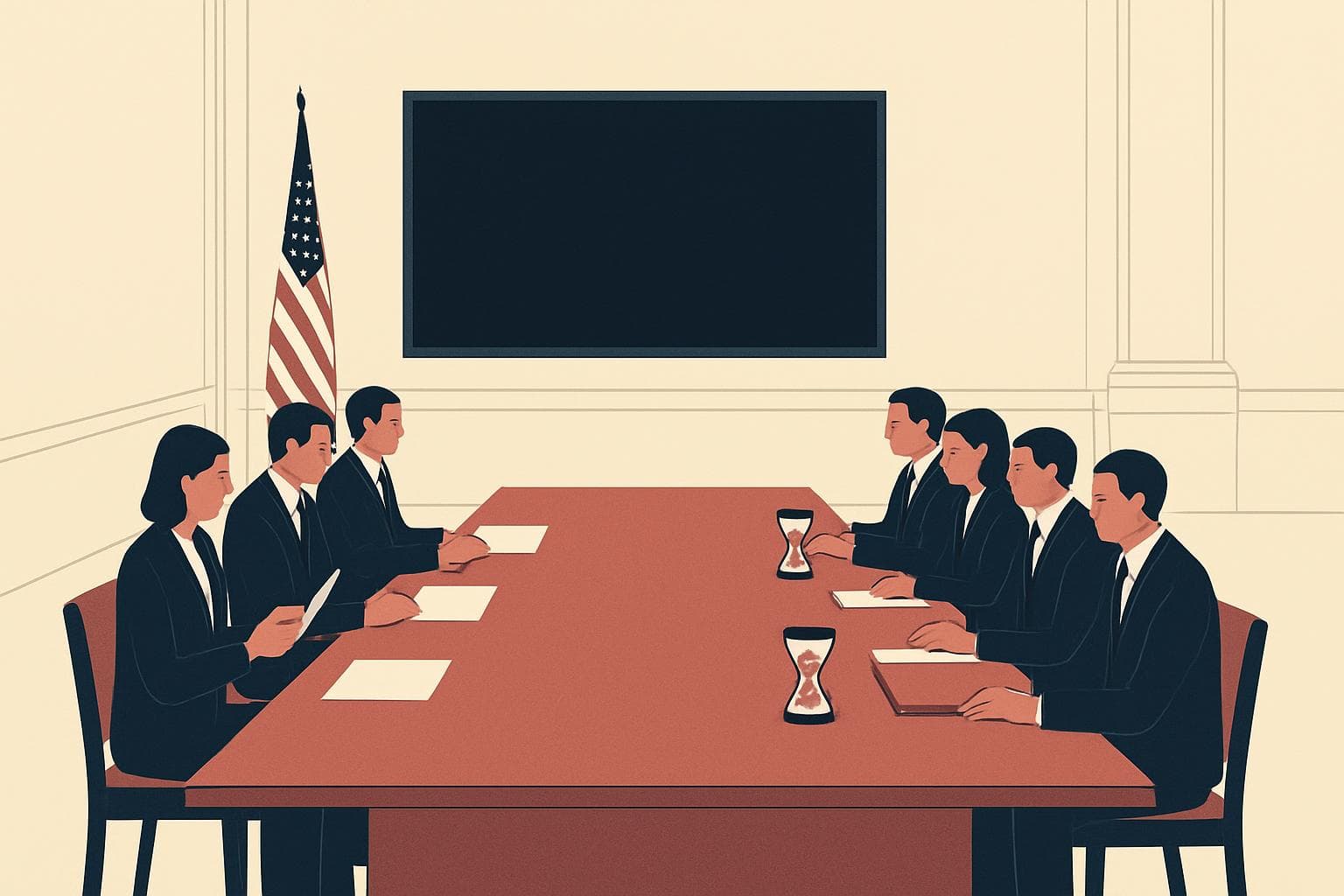
U.S. political and industry leaders are sharply divided over how to manage the development of artificial intelligence (AI): one camp pushes for acceleration and limited regulation, while the other calls for slowing progress and stronger oversight.
Trump’s accelerationist stance
President Donald Trump has taken an "all-in" approach to AI: prioritize rapid development, minimize regulation and focus on beating China. In a speech in Ireland on Sunday he dismissed new safety warnings as the product of “a lot of negative forces,” and distilled the stakes into a single line: "Whoever wins AI wins."
Among Trump’s allies and supporters — including venture capitalists and former administration advisers — there is a common view that safety alarms are sometimes tactical moves by dominant firms seeking favorable rules. David Sacks, who served as an AI czar in the Trump administration and is a prominent voice for a hands-off policy, has argued that companies should slow themselves if they believe the frontier is moving too fast rather than using Washington to constrain competitors.
House Speaker Mike Johnson (R-La.) echoed that self-regulation argument and rejected calls for an emergency moratorium. On NBC’s "Meet the Press" he said he would recall the House and put AI regulation to a vote "if we had the solution," but warned against rushing into poorly understood rules. Johnson has proposed an early summit that would bring President Trump, congressional leaders and the heads of major AI labs together to work out a common safety approach.
Democratic urgency, but divergent remedies
Democrats are coalescing around the need to act quickly, but they lack a single, agreed doctrine on what action to take. House Minority Leader Hakeem Jeffries said his caucus will meet Tuesday to debate possible steps, and former President Barack Obama is reportedly urging the party privately to prioritize AI.
Proposals among Democrats range widely. On the progressive end, Sen. Bernie Sanders (I-Vt.) and Rep. Greg Casar (D-Texas) have called for banning superintelligence, pausing advanced AI development and imposing penalties up to 20 years in prison for violations. Other lawmakers favor more conventional Washington tools: Sen. Ruben Gallego (D-Ariz.) proposes a bipartisan AI select committee with subpoena power, while Sen. Chris Van Hollen (D-Md.) demands that OpenAI subject its models to federal safety reviews.
Industry warnings and public unease
Notably, leaders of major AI labs — including Anthropic, OpenAI, SpaceXAI and Google — have urged slowing or "pacing the frontier." That rare call from inside the field has already shifted some political views and could reshape the debate.
For example, Michigan GOP Senate nominee Mike Rogers, a Trump ally in a swing state, said that a new warning from Anthropic CEO Dario Amodei convinced him "we must slow down development" so government can catch up. Sen. Josh Hawley (R-Mo.) is investigating AI’s "existential risk," while Sens. John Thune (R-S.D.) and Amy Klobuchar (D-Minn.) are pursuing a narrower plan that would require companies to test for and report catastrophic risks.
Outlook
Political pressure and lobbying might open the door to narrow bipartisan measures, especially where public concern and industry cautions converge. However, any significant federal regulation would still face the prospect of a presidential veto. For now, Washington remains deeply split on whether AI is primarily a national triumph to be unleashed or a national emergency to be contained.
Key takeaways
- The Trump-aligned camp favors rapid AI progress and lighter regulation.
- Many AI labs and numerous Democrats call for slowing development and imposing stronger oversight; proposals span from bans to targeted testing and oversight mechanisms.
- Meaningful consensus this year appears unlikely, and substantial legislation could be blocked by a presidential veto.