ResearchState-aligned Media Shapes LLM Output, Strongest Effect in ChineseResearchers from multiple universities found that state-affiliated media present in web training data skews large language model (LLM) outputs toward government-favorable views, especially when models respond in the language of a country with restricted press freedom.5 min read
ResearchAI Enables Monthly Mapping of Glacier Calving Fronts with Near-Human AccuracyResearchers at Friedrich-Alexander University trained an existing glacier-tracking model to identify calving fronts using minimal local data.3 min read
ResearchComparison of Claude Fable 5's performance with different modelsThe comparison of the artificial intelligence model named Claude Fable 5 with various models presents its performance and behavioral differences; the analysis helps developers and users with model…1 min read
ResearchAnthropic: Data and APIs, Not Model Intelligence, Were the Bottleneck in Biology TasksAnthropic argues that AI agents perform well on coding tasks but struggled in biological retrieval because databases and APIs are designed for human web browsing, not agent access.2 min read
ResearchAI-designed universal coronavirus vaccine shows promise in Phase I trialResearchers at Cambridge University used artificial intelligence to identify conserved viral targets and developed a vaccine candidate, pEVAC-PS, that proved safe and cross-reactive against multiple coronaviruses in a Phase I study of 39 volunteers.2 min read
ResearchFine-tuning Can Make LLMs Reproduce Large Portions of Pretraining BooksFine-tuning large language models to expand plot summaries into full paragraphs can cause the models to output long verbatim passages from books they saw during pretraining.3 min read
ResearchAI model and researchers jointly found a counterexample to an 80-year-old Erdős conjectureResearchers Alex Wei, Hongxun Wu and wjmzbmr1 reported on the OpenAI Podcast with Andrew Mayne that an AI model they used found a counterexample to an Erdős conjecture standing for about 80 years.1 min read
ResearchAnthropic Institute researches the societal and safety implications of self-improving artificial intelligenceAnthropic Institute announced that, together with external actors, it is researching the societal, medical and economic impacts of increasingly advanced, potentially self-improving systems—such as…1 min read
ResearchMythos Preview often gave better suggestions for research steps than human researchersThe system Mythos Preview suggested a better next step than human researchers 64% of the time when evaluating research sessions that had gone off track; this is a significant improvement over 22% in 2024.1 min read
ResearchMythos Preview achieved a 52× speedup on a code-optimization test, Claude Opus 4 only ~3×Two large language models were compared on a code-optimizing test: Claude Opus 4 achieved on average about a 3× speedup in May 2024, while the April Mythos Preview showed roughly a 52× improvement.1 min read
ResearchEnsuring sex-aware digital twins in cardiologyDigital twin technology promises personalized cardiology by creating patient-specific virtual heart models, but its effectiveness depends on representative, sex-aware medical data.4 min read
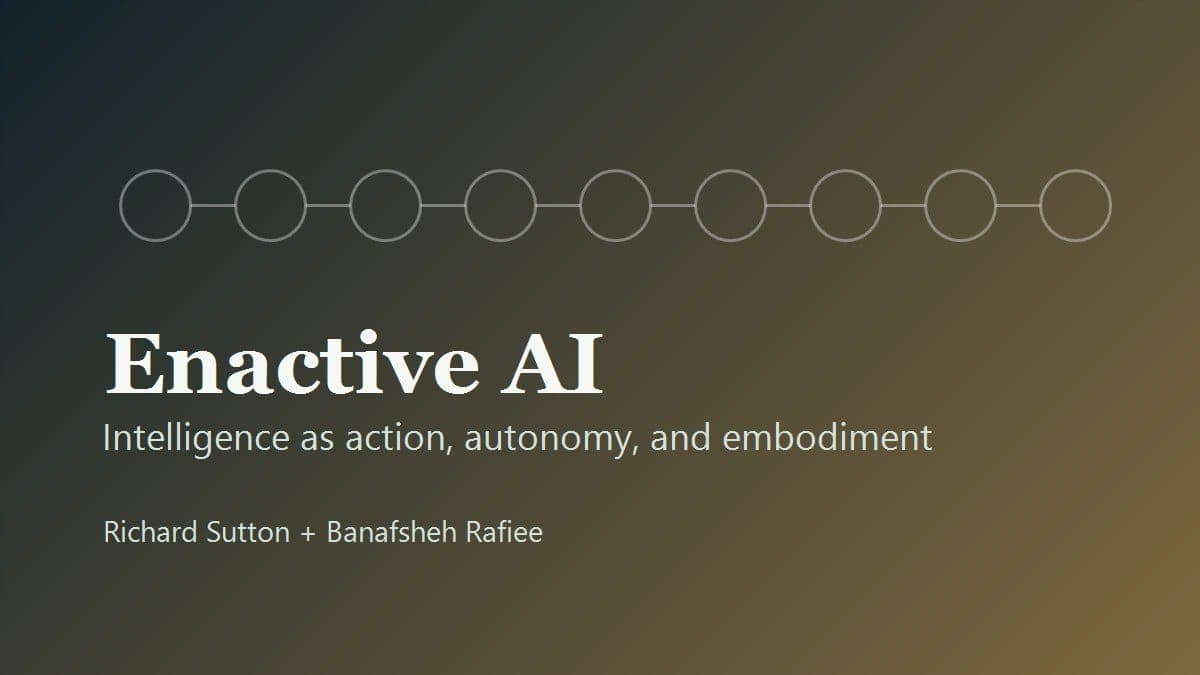
ResearchRichard Sutton and Banafsheh Rafiee Outline 'Enactive AI' Vision but Offer Few Practical StepsRichard Sutton and Banafsheh Rafiee propose "enactive AI," an approach that treats intelligence as something emerging from agents acting in environments rather than from passive prediction on labelled data.2 min read